


Affect is a verb that means to influence or bring about a change in something, while effect is usually a noun referring to the result or outcome of that change. However, effect can sometimes be used as a verb, meaning to bring something into existence.
These words are examples of homophones: words that sound alike but mean different things. Understanding homophones is essential in English grammar. Why? Because we have loads of them, and using the wrong one can really confuse things. They’re tricky for everyone, whether you grew up speaking English or you’re just learning. It’s not just about how they sound; you’ve got to know the situation to pick the right word. So, I’ll dig into the unique meaning and usage of both affect and effect, sprinkling in examples to help you solidify your understanding. After reading my quick guide, you won’t ever get these terms mixed up again.
Effect Or Affect
Effect is usually a noun and is defined as “a result of the change”, as in “exercise has had a positive effect on my health”. Affect is usually a verb and means “to cause a change or impact”, as in “his lack of sleep affected his mood”.
Guideline for Affect vs. Effect
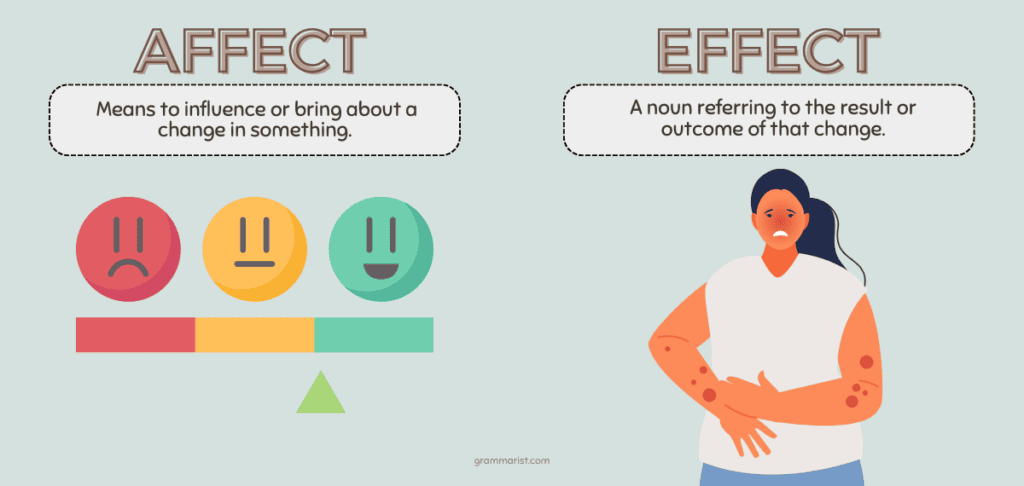
Affect and effect are definitely a pair of those tricky words that always leave writers confused.
Here is an example to illustrate that effect is a result of the change and affect is causing the change, “Chanel is having a price increase on their bags”. Chanel, a brand, is the one that affects the price of their bags. And the price increase is the effect that Chanel has produced on the bags.
Affect and effect also sound similar, which is why we tend to mix them up. But effect has a stronger and longer “eh” sound, such as in “there.” Affect’s first syllable is shorter with an “uh” sound.
Affect, when used as a verb, means “to act on or change someone or something.”
‘Affect’ as a Verb
Affect is a verb meaning with three different uses:
- “To act on” or “to create a change in”
- “To touch someone’s emotion” or “to move someone”
- “To pretend to feel or have something”
If a presidential candidate wants to “create a change” in the country, she should positively affect its people. Let’s look at some scenarios with affect in a sentence using the first definition:
- I need to get an electric heating pad because the cold weather has affected my pipes.
- Maya is undergoing therapy because her disease has affected her speech.
- The digital divide disproportionately affects low-income individuals and families.
Check out these other words for affect, which you can use in your speech or writing:
- Influence
- Act on
- Work on
- Sway
- Transform
Have you ever met someone so inspiring or alluring? If yes, they have affected you. Take a look at these examples of affect in a sentence using the second definition:
- The divorce could affect their kids.
- Thousands of people were affected by Princess Diana’s sudden death.
- That one event in June 1977 affected her most deeply.
Some alternatives for affect in this context include:
- Hit hard
- Upset
- Trouble
- Distress
The third definition of affect is the least common one. Here’s an example:
- Jack is an Australian man who affected an American accent.
Some synonyms of affect using the third meaning include:
- Assume
- Put on
- Pretend
- Counterfeit
- Fake
- Feign
Take note that affect is in a verb version most of the time. So, here are incorrect ways to use the verb affect:

- Social media has a significant affect on teenagers’ mental health.
- I want my next song to have a sad affect on my audience.
More Affect Examples
The storm knocked down power lines, affecting several thousand people in rural communities. [CBC]
‘Effect’ as a Noun
When dealing with nouns and verbs for easily confused words, there are a few simple things to remember.
The primary guideline for effect is always to use it as a noun. Effect refers to “a change which is an outcome of a specific action, event, or other cause.” Here are some sentence examples:
- A corrupt government can have terrible effects on people. One effect is an increase in social inequality.
- Some temporary side effects of the vaccine include fatigue and nausea.
- After six months of using this eye cream, I can say that it doesn’t have any effect.
You’ll often find the word effect in the field of research. For instance, experts want to find out if one scenario has an effect on another event. Or they want to answer what the effects of a particular phenomenon are. This study is known as causal or experimental research.
Again, effect is in noun form most of the time. Avoid structuring your sentences like these:
- The breakup effected Janna so much that she cut her hair too short.
- Everything in the universe is effected by gravity.
- How did the Clean Green Movement effect the industry where you work?
Avoid repetitiveness by using these synonyms for effect:
- Result
- Reaction
- Repercussion
- Consequence
- Outcome
More Effect Examples
A New York City law that will go into effect this spring will require companies to reveal the salary ranges on job postings. [NY Post]
“It has hidden its own research on addiction, and the toxic effects of its products,” he said. [The Guardian]
Affect vs. Effect in Sentences
The confusion between affect vs. effect is understandable. Although the two words have different meanings and parts of speech, they are used in similar contexts. Here are more sentence examples so you can familiarize yourself:
- Moving to the East Coast greatly affected my lifestyle.
- A competent person can profoundly affect a crowd with her story.
- The weather conditions have been affecting my health recently.
- The pandemic affected all my plans for the summer.
- Why would someone’s success affect your ego?
- I have to admit, running produced beneficial effects on my cardiovascular health.
- Is it true that fast fashion has destructive effects on the environment?
- Shopping with a credit card has effects on your ability to get a loan.
- This scar is the effect of my carelessness as a child.
‘Affect’ vs. ‘Effect’: How to Remember the Difference Between Them
There are three tricks to help you pick the right word.
RAVEN
The acronym RAVEN is a memorization strategy for choosing between affect and effect. It stands for:
R = Remember
A = Affect is a
V = Verb, while
E = Effect is a
N = Noun
Verbs are words that express time while showing an action, condition, or the fact that something exists. In this case, affect is an action word that means “to create a change in.”
To express time, you can use the verb affect in different tenses. Its present form is affect or affects, while its past tense is affected. The correct verb form for the future tense is “will/shall affect.”
Effect is a noun that means an outcome or result. Nouns identify persons, places, things, events, and ideas. Effect can be under the idea category.
Affect Starts With A, So Does Action
Another way to distinguish between affect and effect is to look at their first letters. Affect starts with an A, and so does action. For example, if my groupmate’s performance affected my grade, it means his contribution to the project impacted my grade.
Effect starts with an E, and so does end result. That means his performance had an effect on my grade since my grades are an end result of his performance.
Use of Articles
Use the noun effect if you have to use “an” or “the” before the word. Articles are adjectives that also describe nouns and pronouns. Use “the” if the effect is particular or definite, and use “an” if it is indefinite or one of many effects.
A Few Rare Exceptions
You should have mastered the policy in affect or effect by now. Effect is a noun, while affect is a verb. But in infrequent situations, effect can be a verb, while affect can be a noun.
To give you an idea, activists often want to effect change in unethical corporations. However, people who work in these corporations do not always have an affect on these issues.
Effect as a Verb
The verb version of effect means “to bring about.” It usually appears next to the word solution or change. So, if you want to effect change, you want to bring about transformation, say in your company or the government.
How is that different from affect as a verb? Affect as a verb means “to impact change.” If activists want to affect change, it means they want to have an effect on current changes. This statement sounds less radical than trying to effect change.
Another example is when an excellent educational system allows the youth to effect change in many ways. When reforms are made in education, students will become more socially aware and inspired to transform society.
However, if the youth affects change, it merely means they want to modify, speed up, or stop changes in society. That’s why the phrase effect change is more appropriate in most contexts.
Affect as a Noun
The noun version of affect is a popular term in the field of psychology. It means emotion, feeling, or an emotional response. When a business magnate has no affect regarding the factory accident, they do not express feelings on the issue.
Affect is a broad jargon in psychology that you will often find in scholarly articles. Those who study human cognition, brain activity, or basic feelings are more likely to use the word.
When someone shows anger or sadness when opening up in a therapy session, they might have a profound affect. It’s much better to use affect as a noun in this context. Otherwise, you can say emotion or feeling.
Affected as an Adjective
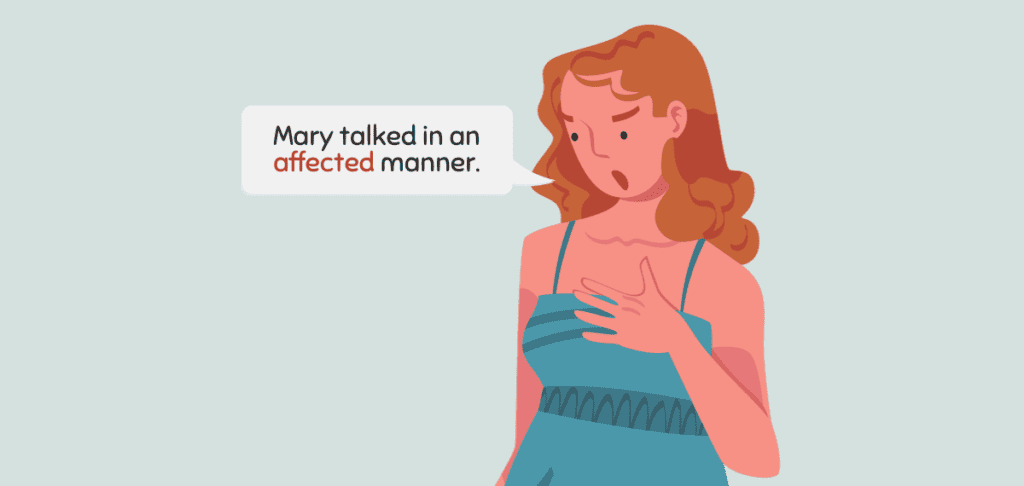
Affected is the simple past form of the verb affect. However, it can also be an adjective that means:
- Showing a behavior or attitude that is not genuine
- Assumed falsely
- Inclined
Check out these examples of affected as an adjective in sentences:
- I know someone who has an affected interest in poetry.
- Mary talked in an affected manner.
Is it Personal Effects or Affects?
The correct term to use is personal effect or personal effects. That is because the word personal is an adjective, and adjectives describe nouns and pronouns. Effect is the proper word to use since it’s a noun.
Personal effect is a legal term for someone’s property that is typically worn, handled, or carried. Examples of personal effects are jewelry and clothing. Personal effects are also objects with spiritual or cultural relevance, such as a rosary.
Here are some examples of the use of personal effect in sentences:
- My job involves rescuing victims and their personal effects.
- Caitlyn will inherit her mother’s personal effects.
- She’s not aware of the loss of jewelry and other personal effects.
Is it Knock-On Effect or Affect?
Knock-on effect is also a common phrase that uses the word effect. We say knock-on effect instead of knock-on affects because knock-on is an adjective. And adjectives describe nouns and pronouns, which is what effect is.
The phrase knock-on effect means an action, event, or process that results in other events happening. This effect is usually secondary or indirect. Here are some examples:
- The truck factory’s closure could have a knock-on effect on tire manufacturers.
- The increase in vegetable prices had a knock-on effect on the community’s health.
- The creation of green jobs has a knock-on effect on the country’s GDP.
More Affect vs. Effect Information
Affect and effect have different pronunciations and definitions, but both can be verbs and nouns in different contexts. Here are other uses of the two words.
Affect Studies
Affect studies is an academic discipline under the field of psychology. It deals with the study of affect or emotion. Affect theory is a theory that categorizes affects or feelings. It also shows that feelings have different physical, social, and other manifestations.
Affective vs. Effective
Affective is an adjective that means it produces an effect in an emotional sense. Here are some examples:
- Psychological affective disorders like depression can cause a patient to have a negative body image.
- Lack of sleep can have negative affective impacts.
Effective is also an adjective that means successful. If something is effective, it can produce the desired result. Here are some examples:
- The new classroom rule is effective at preventing academic dishonesty.
- Retinoids are the most effective treatment against acne, so dermatologists deem it the gold standard.
Bottom Line
Affect vs. effect is complicated because they sound the same, and we use them in similar situations. Most of the time, you use affect to express action and effect to identify an idea. Affect means “to create a change in,” while effect means “an outcome of a specific action.”
Did this guide positively affect your grammar skills? I hope it made an effect on your speech and writing.
If you’re still confused, take note of the RAVEN acronym. Just tell yourself, Affect is a Verb, and Effect is a Noun.