


Dice serves as the plural form, referring to more than one cube, while die refers to a single cube marked with numbers from one to six on its faces. The plural form has been debated for years—especially by people who play board games. Die and dice get mixed up all the time, but there’s a difference in their meaning and intended usage.
Understanding the difference between die vs. dice is just another stepping stone toward clearer, more accurate communication. In my quick guide, I’ll review both terms’ meanings, usage, and examples to help you use them correctly.

Is Dice Singular Or Plural?
Dice can be used for both singular and plural forms, whereas die is singular. If you roll a die, you are rolling one game piece. If you roll dice, you are using one or more game pieces.
Dice or Die – What’s the Difference?
The singular form for dice is originally die. But modern English now considers dice as both singular and plural nouns because of how language evolves.
First, let’s establish that die and dice can both be nouns. They also have one definition in this context.
Dice is a noun that can be singular or plural if you’re using modern standard English. It means “a tiny cube with different 1 to 6 dots on each side.” If there are two of these items, we still refer to them as dice.
Die, which originates from the French word des, is the original singular form of dice. It’s also a cubed game piece with different amounts of dots on each side. We see these game pieces in board games, betting games, role-playing games, and table games.

Examples
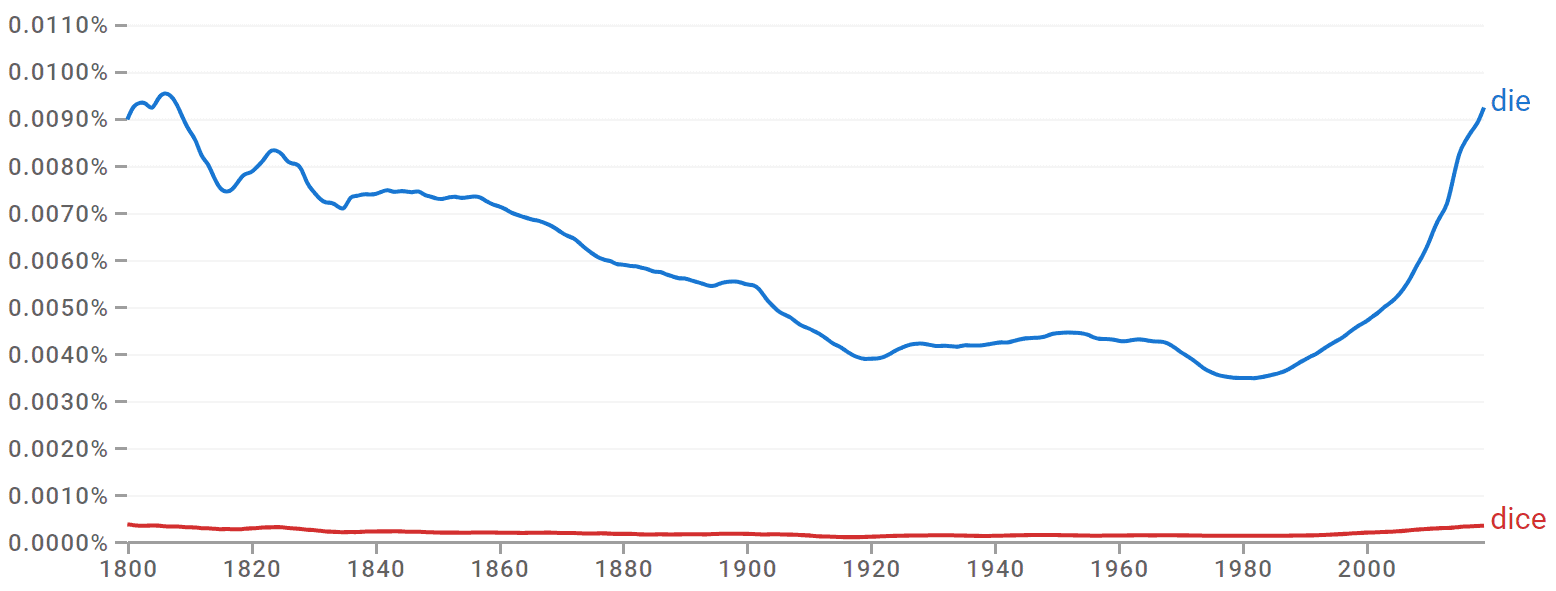
Dice has become more common than its singular form, so many writers forget to use die at all. Here are some examples:
- If the dice is rolled and there is a choice, what do we need to consider?
- It’s my turn to roll the dice.
- You don’t need a dice for a game of Uno.
The singular noun form die was more common in earlier times, such as in Julius Caesar’s the die is cast. But he initially used the sentence in Latin.
If we continue using dice as a singular noun, we may accept the change in its use. Language authorities like the Oxford Dictionary accept it already. But formal and careful writers still use die.
What Are Irregular Plural Nouns
Ideally, we use the plural form by adding -s or -es. But irregular plural nouns like dice change their spelling. For many historical reasons, die becomes dice, and mouse becomes the noun mice. Ox even becomes oxen!
One common rule in using irregular plurals is replacing -f and -fe with -ves, such as knife with knives. Another guideline is to change vowels, like foot and feet.
How to Use Dice in a Sentence
Some people confuse these terms as homophones, but they’re not. If you’re following modern grammar rules and using dice in singular or plural form, you may consider it a non-count noun. But if it’s strictly in plural form, dice is a countable noun.
Here’s an example of dice in singular form:
- The dice was already rolling when Ken decided to join the tabletop game.
How do you know that dice here is in singular form? Take a look at the verb phrase “was rolling.” The helping verb “was” is in the singular form to agree with the singular subject, dice. If we say that the dice were rolling, they could be using two or more game pieces.
Examples of the Singular Dice in Sentences

- I got this dice from my uncle’s antique store.
- Could you not touch the dice while it’s rolling?
- The way the dice is loaded, as things stand, the company takes on interest-bearing loans and, in turn, advances interest-free loans to its 100% owned subsidiaries. [Equity Master]
- Players take turns rolling the die and then drop whatever piece the die chooses. [Chip Chick]
- If the dice is rolled and there is a choice, what do we need to consider? [Irish Times]
While the word dices exists, it does not refer to the plural form of dice. Remember that dice is already in plural form. Read these examples of the plural dice in sentences:
- My father used to collect unique designs of dice.
- I have three extra dice in case Shannon loses them.
How to Use Die in a Sentence
The word die might be a confusing noun because it’s not common anymore. But it’s simply the singular form of the tiny object with numbers 1 to 6 on each side. Here are some examples of die in a sentence.
- We can’t have family game night if we don’t have a die.
- Players need to take turns rolling the die.
A die will be rolled in front of the audience, and the result will determine which half of the dance goes first and which score, costumes, and lighting will be used. [The Detroit News (article now offline)]
Die is also a verb that means to cease living. Die as a “singular game cube” and “to stop living” are examples of a homonym. Check out these examples of die in the verb form.
- She died peacefully in her sleep.
- What happens when an engine dies while I’m driving?
Trick to Remember the Difference
One way to memorize die and dice is to remember that die is shorter than dice. It has fewer letters, and singular nouns are fewer than plural.
Dice also sounds like it ends with the letter S. And you know that regular plural nouns end with an s.
In Conclusion
Die and dice have identical definitions. But their difference lies in whether it’s the singular or plural form.
Use dice in its original plural form or singular form for informal or modern sentences. And use die as the singular form of die.