


So, the news announced that the latest polls for the presidential candidates are neck and neck. What does this saying mean?
Keep reading to learn what neck and neck means and how you can use it in a sentence. You’ll also learn the origin of the idiom and when it was first used.
What Does Neck and Neck Mean?

Neck and neck is an idiomatic expression used as an adverb or adjective, which refers to very close, as in a race.
If two contestants are neck and neck, that means their ranking or levels are very close to each other. In other words, the two competitors have an equal chance of winning.

Neck and neck also describes two things with similar qualities without the element of competition. For example, you might be choosing between two cars that are neck and neck when it comes to gas mileage.
Other similar words for neck and neck include photo-finish, even, close, indeterminate, and level.
Origin of the Phrase Neck and Neck
The phrase neck and neck was initially used in horse racing when two horses are racing close to one another. People say the two horses are neck and neck as they are close to the finish line. They also mention the phrase when the horses are beside each other.
The saying was first used in the early to the mid-19th century. But its earliest recorded use was in 1825. It’s from a newspaper entitled Dalrymple Advertiser, saying
“The owners rode their respective horses, and the race was said to be the finest ever witnessed on this turf, both horses keeping neck and neck round the course.”
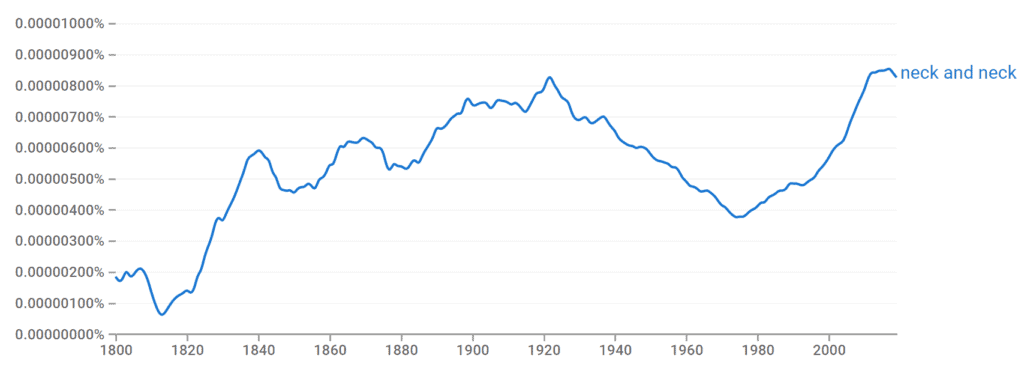
Over the years, the phrase neck and neck has morphed and been used in several ways to convey the expression.
Examples of Neck and Neck in Sentences
Trump-backed Blake Masters won the GOP nomination for Senate in Arizona. Kari Lake and Karrin Taylor Robson were neck and neck in the race for the GOP nomination for governor [Wall Street Journal].
Lebanon’s parliament once had a clear majority for Hezbollah and its allies but since elections, in May it now stands neck and neck with some of its staunchest opponents, most notably the Christian Lebanese Forces party. [AP News].
Running almost neck and neck with salary was complaints about the inspirational and caring qualities of their leaders. [Nasdaq]
“It’s always been neck and neck – last time it was my turn, this time she got the win. I’d have preferred it at the Commonwealths, but I tried my best.” [Yahoo Sports].
“How are those guys going to perform? So, it’s not necessarily a bad thing, they’re getting more reps and it really helps us from an evaluation standpoint, and they both have accepted it very, very well. They’re kind of neck and neck right now which is not a bad thing.” [ESPN]
Summary of Neck and Neck
Have you ever watched a close basketball game? Well, the team must have been neck and neck. Remember that the idiomatic expression neck and neck can be an adverb or adjective that means so close together in a race or contest.