


I see the simple words “loose” and “lose” get confused all the time due to their almost similar spellings and pronunciation, but they have distinct meanings and uses.
We should all understand the differences between these two words in order to use them correctly in written and spoken language. I break down everything in this quick guide and even include some examples of both words in sentences.
Loose vs. Lose: What’s the Difference?
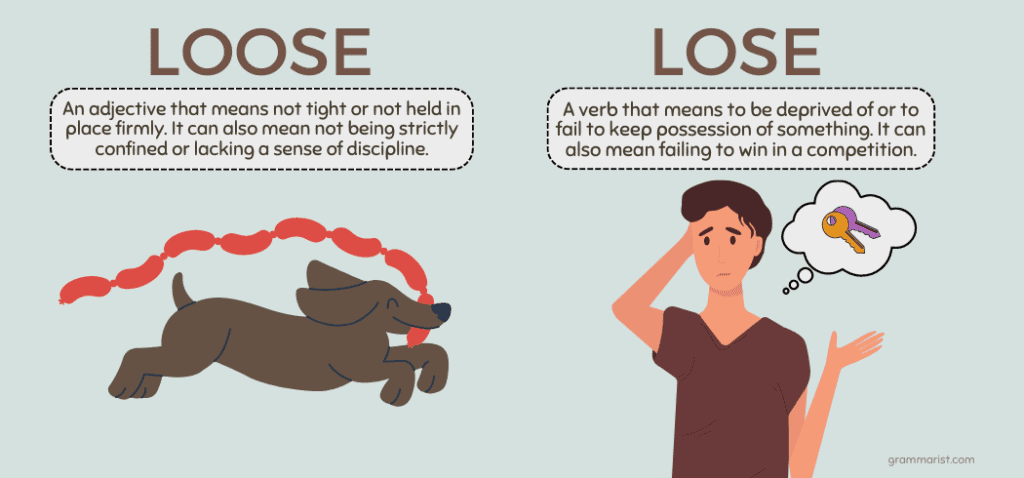
The difference between lose and loose is simple, but it doesn’t stop people from mixing them up all the time.

The word “loose” is an adjective that means not tight or not held in place firmly. It can also mean not being strictly confined or controlled or lacking a sense of restraint or discipline. For example, a loose shirt is one that is not fitted closely to the body, and a loose dog is one that is not on a leash or otherwise restricted.
The word “lose” is a verb that means to be deprived of or to fail to keep possession of something. It can also mean failing to win or being defeated in a competition or contest. For example, if you lose your keys (which I do all the time), you no longer have them in your possession, and if you lose a game, you are not the winner.
How Do You Use Loose in a Sentence?
The proper usage of the word “loose” is straightforward. It should be used as an adjective to describe something that is not tight or not held in place firmly.
- I need to tighten the loose screws on this chair.
- She has a loose interpretation of the rules.
- My daughter has a loose tooth; it should fall out any day.
- I have a lot of loose coins in my car.
How Do You Use Lose in a Sentence?
The right usage of the word “lose” is also straightforward. It should be used as a verb to indicate that something has been lost or that possession of something has been relinquished.
- I can’t find my keys anywhere; I must have lost them.
- The team will lose the championship game.
- Did you lose all that money gambling?
- I can’t bear to lose you; I love you!
It’s definitely important that I note the word “loose” cannot be used as a verb, and the word “lose” cannot be used as an adjective. Using these words incorrectly can lead to confusion or misunderstanding, so use them correctly in order to convey the intended meaning effectively.
Other Confused Spellings
- looses vs loses
- loosing vs losing
A Final Tip
Both words “loose” and “lose” are confused more often than not because they’re almost spelled similarly and sound a lot alike, but they have distinct meanings and uses. “Loose” is an adjective that means something not tight, while “lose” is a verb form that means to have lost something. Make sure you’re using both terms in the proper context and with the right spelling.
Comments are closed.