


For English speakers, it’s always essential to further learn grammar rules. Or is it “farther learn grammar rules”? Is it further or farther? I often get these mixed up myself.
These two simple words look and sound the same. But their meanings and usage vary. Keep reading to learn the differences between further and farther with my examples.
Farther vs. Further
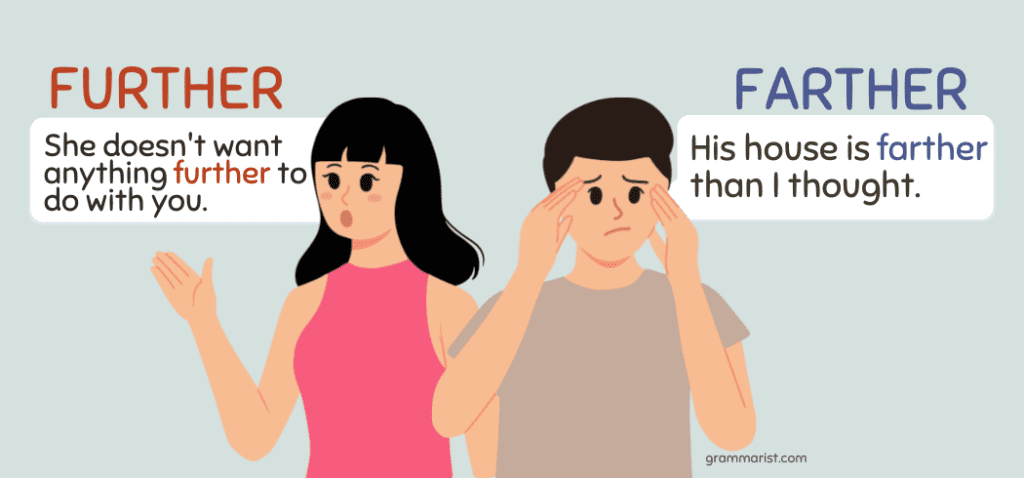
Both farther and further are correct. You might think they’re synonymous, but they have different meanings and uses in English.
The standard quick answer is “farther is for physical distance, while further is for figurative distance.”
Farther Definition
The word farther means at or to a greater distance. This adverb or adjective is the comparative form of far. For example:

- The Earth reminded us of a Christmas tree ornament hanging in the blackness of space. As we got farther and farther away it diminished in size. Finally, it shrank to the size of a marble, the most beautiful marble you can imagine. -Jams Irwin.
- His house is farther than I thought.
- The school and church are located on the farther side of the city.
But aside from physical distance, farther also refers to a more advanced point or a greater extent. For example:
- Gatsby believed in the green light, the orgastic future that year by year recedes before us. It eluded us then, but that’s no matter—tomorrow we will run faster, stretch out our arms farther… -F. Scott Fitzgerald, The Great Gatsby
- The strategies can be refined farther.
- The mayor will proceed no farther with the policy change.
Further Definition
First, let’s discuss the slight overlap between further and farther. As an adjective, further means more, extended, or additional. It can also mean to a greater extent, referring to a non-physical or metaphorical distance. For example:
- If I have seen further than others, it is by standing upon the shoulders of giants. -Isaac Newton
- Can you explain the second part of your essay further?
- She doesn’t want anything further to do with you.
As a verb, further means to advance something. Here are some sentence examples.
- The company has decided not to further this project.
- Our group’s efforts have significantly furthered artificial intelligence.
- The funds from the auction will be used to further the public good.
The Common Definition of Farther and Further
The Chicago Manual of Style responded to Webster’s 11th Collegiate Dictionary, stating that both words have been used interchangeably throughout history. For example:
- Come further up, come further in! -C.S. Lewis, The Last Battle
In this book excerpt, further is used with the definition of farther, which is at a greater distance. Here are more examples.
- The carabaos are already exhausted. But I have further to go.
- I live further from his office.
However, as time passes, further’s and farther’s definitions are diverging. Further is the older of the two words. Farther comes from further as a variant in Middle English.
We can still use them interchangeably as adverbs when showing spatial or metaphorical distance. That’s because it’s not always clear when we mean physical or non-physical distance.
For instance, when reading a book and you want to reach a certain page, do you read further or farther?
But when we’re not discussing distance, the correct term is always further.
Is It Further or Farther Away?
Both further away and farther away are correct. As mentioned, the two words can be used interchangeably, especially if the type of distance is ambiguous.
Is It Go Further or Farther?
Both are correct, depending on what you mean. Go farther means to go at a greater physical distance. For example:
- We need to go farther if we want to see the fireworks.
Go further means to advance something. For example:
- I’m excited to go further with you on this collaboration.
Farther vs. Further Summary
Even the best writers get confused between further and farther. While some style guides think it’s acceptable to use them interchangeably, it’s much better to learn when to use farther and further.
- Use farther as an adjective when referring to physical distance.
- Use further as an adjective when referring to metaphorical distance.
- Use further as a verb that means to advance something.
Comments are closed.