


Do you get confused between the words creeped and crept and struggle to remember how to use them? Both are correct and valid words, which just makes it all the more confusing. So, I’ll explain the meanings behind both and how you should be using them within proper contexts.
Is It Creeped or Crept?
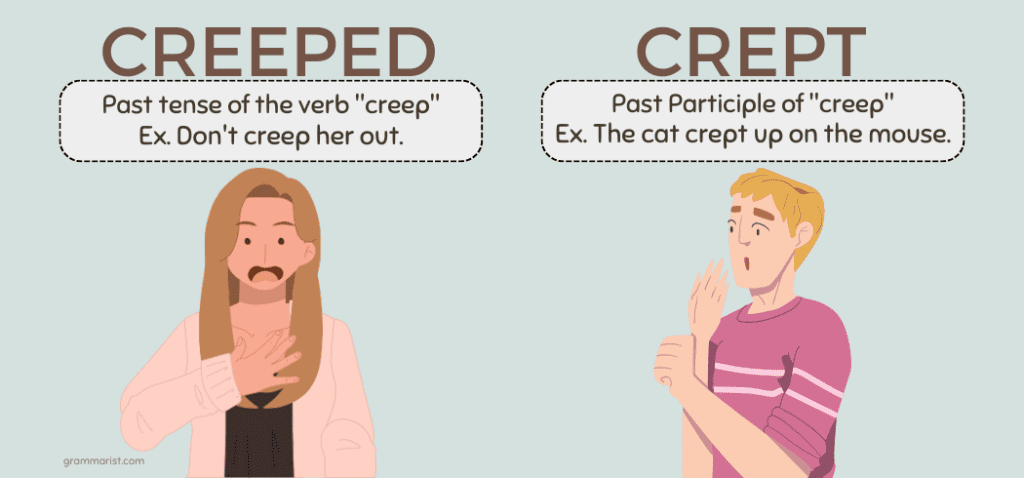
The real answer depends on the context that you’re using around the word. Both “creeped” and “crept” are always valid forms of the verb “creep.” The difference is that we use them in separate ways.
When to Use Creeped
Essentially, “creeped” is just the past tense of the verb “creep.” We use it to describe an action that took place in the past and is now, in the present, completed. If you snuck up behind your friend yesterday, today you’d say, “I creeped up behind Alison and scared her.”

Now, there is also the late 20th-century phrasal verb using creep and creeped that is set apart from this. You’d use it to explain how someone or something makes you feel.
- He creeped me out.
- I was creeped out by that.
- Don’t creep her out.
When to Use Crept
Then there’s “crept.” While “creeped” is just the past tense version of “creep, this is the past participle of it. You’d use it to describe an action that took place and has been completed in the past but still has ongoing consequences.
One place you’ll see it used a lot is in fiction novels written in the third person POV. “The vampire crept into the room, hoping not to be seen.” See how it states that the vampire already entered the room, but we still don’t know how it ends?
Is Crept a Past Participle?
Indeed, it is! “Crept” is the past participle of “creep.” I know it sounds confusing, so I’ll show you two sentences that use both forms.
- Past participle: The cat crept up on the mouse, ready to pounce.
- Past tense verb: The cat creeped up on the mouse and pounced.
What’s the Past Tense of Creep?
The past tense of “creep” is “creeped,” but the past participle is “crept.” Be sure you’re using the correct form in the context you’re dealing with.
What Are the Synonyms of Creeped?
- Crawled
- Sneaked
- Tiptoed
- Slither
- Lurked
Creeped Examples in a Sentence
- I couldn’t help it, so I creeped around the corner and saw the surprise party my friends had planned.
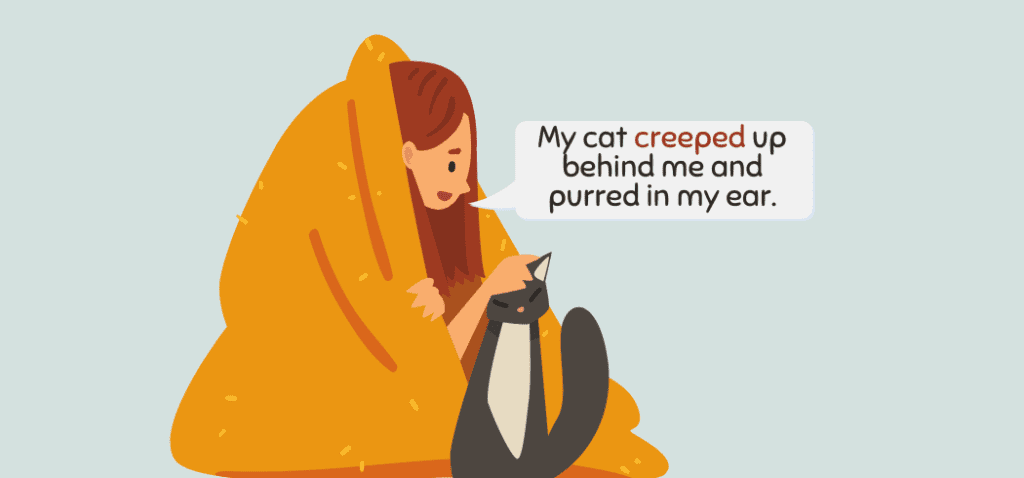
- My cat creeped up behind me and purred in my ear.
- My old neighbor always creeped me out with his strange behavior, always watching us through his window.
Crept Examples in a Sentence
- That snail must have crept across the garden overnight.
- Tiredly, I crept out of bed and tiptoed to the open door.
- I watched as the shadows crept across the room while the sun set.
Don’t Get Creeped Out!
I know it’s a fine line between the words “creeped” and “crept,” but I promise you can get it right! Just remember that “creeped” is the more common way of saying the regular verb creep in the past tense. But “crept” is the past tense form you’d use if the action is still open in the present. I hope I explained it well enough that you understand the difference.
Comments are closed.