


Is it kitty-corner, catty-corner or caddy-corner? Good question, but the answer isn’t as simple as you might think, and as usual, it all boils down to regional preferences. So, let’s unpack this and see which version of this term is most popular and how to decide which one to use.
Meaning of Kitty Corner

You might have heard kitty-corner used in conversations about geography or directions. Despite the cat reference, you’re not supposed to look for a corner full of cuddly kittens (as cute as that sounds).
Kitty-corner refers to a position diagonally across from something. It could be a street, a room, or any other place or space with corners to speak of.
If your house is kitty-corner to the local park, it means the park is located diagonally across from your home. Growing up, my house was across the street from my school, which was convenient, but it wasn’t directly across the street. It was diagonal to the block the school was located, making it kitty-corner to my home.

The past participle would be kitty-cornered or, in the UK, catty-cornered.
Kitty-Corner or Catty-Corner or Caddy-Corner

Much like the phrase itself, its variants are a bit of a cat’s cradle of confusion. Some folks say kitty-corner, others say catty-corner, and yet I’ve even heard some people say caddy-corner. Heck, I’ve even seen it as “kiddie corner,” but I’m sure that isn’t correct.
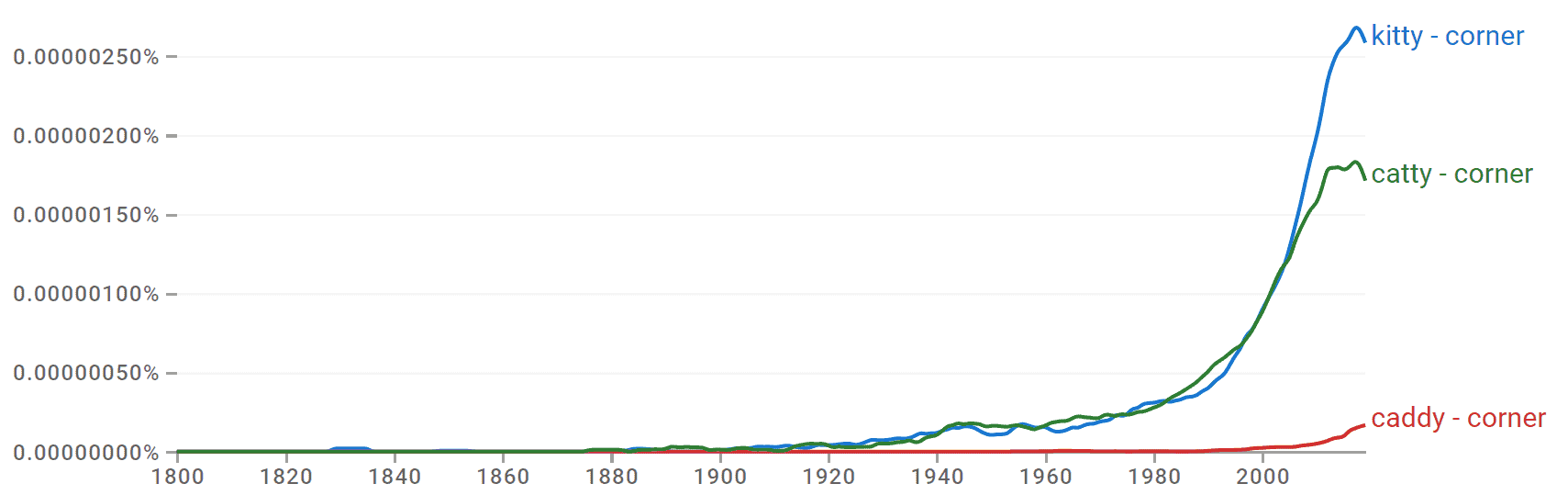
All three versions have been known to appear with and without hyphens, but since they’re classed as an adjective, you should use a hyphen when spelling them. Geez, language is a game of telephone sometimes, isn’t it? While all these versions are perfectly acceptable, regional usage might sway you in one direction.
- Catty-corner is often heard in the UK.
- Kitty-corner is common in the US and Canada.
- And caddy-corner seems to pop up sporadically just about anywhere.
Origin and Etymology Behind Kitty Corner
Now, the etymology of kitty-corner might have you purring with delight or arching your back in surprise. The term was originally catty-corner, which comes from the French word quatre, meaning four.
When English speakers got their paws on quatre, it became cater, used to showcase the four spots on a die or the four legs of a beast. Or, in this case, the corners of four city blocks meeting.
Eventually, cater-cornered became a term for something positioned diagonally from something else, like the opposite corners on a square die. Then, cater-cornered got clipped to catty-corner, kitty-corner and caddy-corner.
Kitty-Corner Synonyms
If you’re looking to mix up your vocabulary, here are some synonyms for kitty-corner.
- Diagonally
- Diagonal from
- Across from
- Cater-cornered (for those who love a bit of etymological nostalgia)
Kitty-Corner Examples in a Sentence

I’ll show you how to use each version in a full sentence so you get a well-rounded idea of how to apply the adjective.
- Our local library is kitty-corner to my favorite coffee shop.
- That new bakery is located caddy-corner from my office building, so I get fresh baked goods every day.
- I live in the old greenhouse that’s kitty-corner from the park.
- You can find our dentist’s office kitty-corner to the pharmacy downtown.
- The bus stop I need to use is conveniently catty-corner to my flat.
Final Words on Kitty-Corner
That’s the ins, outs, and kitty-corners of this fun phrase. So, next time you need to describe something that’s a diagonal corner from something, why not say it’s kitty-corner? It’s a phrase that we’ve been using in English since the 1800s, and I don’t see it going anywhere anytime soon.
Comments are closed.