


Sneaked is the traditional past tense and past participle of sneak. Snuck is new, originating in the U.S. in the early 20th century, but it has become remarkably common across all main English varieties. People seem to like it, and it appears in even the most editorially scrupulous publications, so at this stage there is no basis for saying snuck is incorrect. It’s just new. English has many irregular verb forms, and adding one more won’t cause harm.
In American news publications, sneaked is marginally more common than snuck, and in Canada snuck actually appears twice as often as sneaked. The two words are neck and neck in Australian and New Zealand publications, and in British publications sneaked is about twice as common as snuck. These figures are based on unscientific research, but it’s safe to say British writers shun snuck to a greater degree than the rest of us.

When in doubt, it’s usually better to go with the older form—sneaked, in this case—but there’s nothing wrong with using snuck. Just watch out for English traditionalists with peeves.
Google’s ngrams, which graph word usage across a large number of English-language published texts, aren’t precise, but they nicely render usage trends in visible form. This first one shows the growth of snuck in American English from 1908 to 2019:
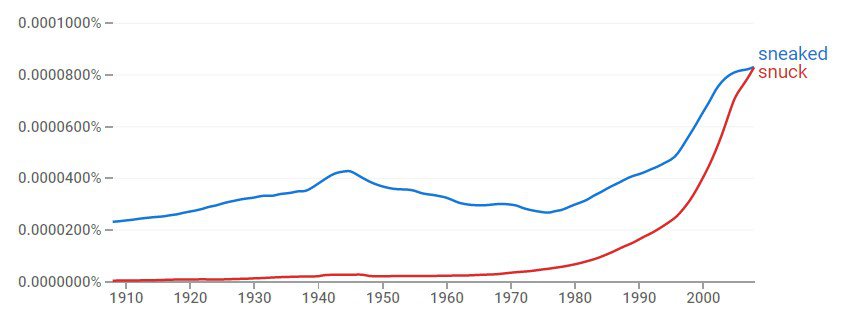
It should be noted, though, that the frequency of snuck on the web is much greater than in books.
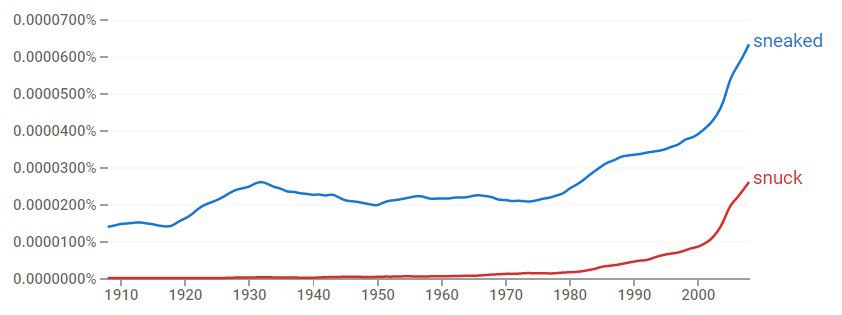
And this one shows sneaked‘s and snuck‘s use in British texts from the same period:
Examples
Snuck
Holmes snuck into the restaurant’s kitchen to make her own baguettes with bakers. [Los Angeles Times]
Chekhov began writing for the stage while he was still at school, inspired by the farces that he snuck into at the local playhouse. [Irish Times]
You felt as though you’d snuck into someone’s home and flipped open his journal. [Globe and Mail]
Perhaps it even snuck up on Swan. [Sydney Morning Herald]
Sneaked
As the fans roared, catcher Rod Barajas sneaked up behind Kemp and emptied a tub of ice water over his head. [Los Angeles Times]
[V]ictory was assured when Mark Foster sneaked home by the same scoreline. [Irish Times]
From there they sneaked into Hong Kong by boat. [Globe and Mail]
A Nepal Airlines Boeing 757 was grounded at Hong Kong’s airport after a mouse sneaked into the cockpit. [Sydney Morning Herald]
Comments are closed.