


Smooth, smoothe, or to smoothen? This truly is the question, and with so many English words spelled multiple ways, it is no mystery why there is confusion over these words as well.
Smooth is a commonly misspelled word, but it never should be used with the letter “e” unless used in the past tense. Let’s take a look at the use of the word smooth, and how to use it properly.
Is it Smooth or Smoothe?
Smooth means free of bumps or wrinkles and works as both a regular verb and adjective. Smooth is the proper spelling and is never written with an “e” unless used in the past tense form, smoothed. Smoothe is a common misspelling and should be avoided.
How to Use Smooth
As mentioned, smooth works as a regular verb and adjective, making it versatile in use. It also conjugates as a regular verb, meaning no “e” is added to any spelling except the past tense smoothed.
Smooth as a Verb
When used as a verb, smooth means to remove bumps and wrinkles.
How to Conjugate Smooth
I/we: first person plural present.

- I smooth the batter before placing the pan in the oven to bake.
You: second person singular and plural present.
- If you want a workable surface, smooth out the paint before adding the primer.
He/she/it: third person singular present.
- She smooths the hair down with a styling product and then begins to curl it.
They: third person plural present.
- If you are looking for good concrete layers, they smooth out the pour before stamping it.
I/we/you/she/they: simple past.
- I watched how he had smoothed out the icing to create a crumb layer before decorating.
Past participle.
- Before I move on to the next step, I will be smoothing out the first layer so it dries evenly.
Smooth as an Adjective
When used as an adjective, smooth means free of bumps or wrinkles. For example:
- The water’s surface had a nice, smooth sheen to it first thing in the morning.
- We had a smooth flight from Dallas to Orlando when we visited my parents.
- She added a smooth top coat of varnish to the table she was refurbishing.
When are Smoothe and Smoothen Used?
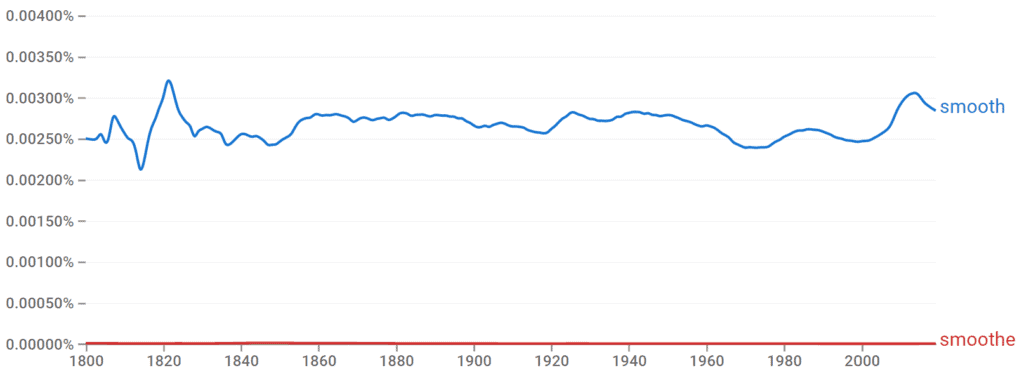
Smoothe is a common misspelling of the verb and adjective form of smooth. It is occasionally published despite being incorrect. This includes the spelling smoothes and smoothing as they are not proper conjugations of the verb form.
Smoothen has made its way into some modern dictionaries and is used to mean to make or become smooth, but the word is superfluous and can always give way to more correct uses of the word smooth.
Smoothen takes on various conjugations in writing and speech, but looks and sounds awkward and incorrect.
How Can Smoothe and Smoothen be Used in Sentences?
Although you should always use the spelling smooth, both smoothe and smoothen make their way into various publications, as we see here:
Blue Line trains will share a track between Stadium-Armory and Addison Road-Seat Pleasant while repairs are made to slabs under the rails to smoothen the ride. [Washington Post]
He and Mr Maroni met last week to smoothe over their row over the handling of migrants … [The Economist]
[L]ong-term investors should make only a small allocation, of 5% or less, to oil or oil-related securities as a way to smoothen volatility in their portfolios. [Wall Street Journal]
How Can Smooth be Used in Sentences?
These sentences use smooth correctly.
Sometimes, getting smooth, summer-ready skin just takes a little bit of prep. “During the summer months, many of us are spending more time outdoors in the hot summer weather,” says Dr. Melissa Kanchanapoomi Levin, a board-certified dermatologist and founder of Entière Dermatology. [CNN]
“It’s important to have a smooth handover and a smooth transition,” said Tarbert. [Reuters]
In a large bowl, mix together all of the ingredients till smooth. [News 9]
Let’s Review
Smooth is the only correct spelling of the verb and adjective use of the word. Smoothe is a common misspelling, and despite some acceptance of both smoothe and smoothen, they are considered incorrect and awkward and should be avoided.