


Many English words are derived from Latin or Greek. And because of that, they generally follow similar rules of making singular plural, such as adding -i to indicate that there is more than one.
This practice is exactly why people confuse octopi with octopuses and why both can be seen in writing. But which is correct?
The answer lies in the word’s origin, a Latinized use for scientific purposes, and a misunderstanding of which plural form to use. We explain those differences and octopus etymology below.
What Is the Plural of Octopus?
Októpus is a Greek word that translates to “eight foot,” a good description of our intelligent 8-footed sea creature that has been known to be an incredible escape artist and problem solver.
In the 1700s, scientists borrowed the word and Latinized it in their categorization of the animal (all animals are categorized using Latin terms that describe their features and/or behaviors). Because of that, many people have mistakenly pluralized the word with an -i ending, as Latin dictates.

However, the correct plural of octopus is octopuses in keeping with the proper Greek pluralization of the word.
Even though octopi is recognized and accepted, octopuses is the correct and more widely used spelling – especially in formal writing and speech.
Origin of Octopi
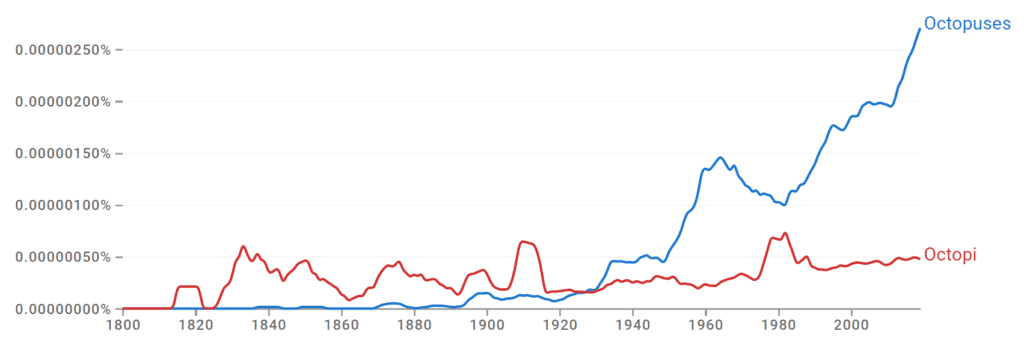
Octopi, the supposed plural of octopus, is a favorite among fans of quirky words, but it has no etymological basis. The form was created by English speakers out of a mistaken belief that octopus is Latin and hence pluralized with an -i ending.
But as explained above, octopus comes from ancient Greek, where its plural is octopodes. Though it came to English via scientific Latin—it was never a native Latin word and didn’t exist in that language until scientists borrowed it from Greek in the 18th century (and if it were a Latin word, it would take a different form and would not be pluralized with the -i ending).
Still, while the use of octopi can’t be justified on an etymological basis, it is not wrong. It is old enough and common enough to be considered an accepted variant.
These examples were found in popular, well-published newspapers highlighting further an acceptable understanding and use of octopi, however wrong it might be:
- A [fishing] ban in the region may affect the market for octopi and marine-based food products …
- Noise pollution knocks squid and octopi off balance.
Octopuses Used in a Sentence
Even though the word octopuses is somewhat bland, it is correct.
For example:
- Octopuses are highly intelligent animals and have been proven to have strong short and long-term memory.
- Octopuses, turtles, and rays glide along the seabed.
Let’s Review
The word octopus comes from a Greek word and was used to categorize the animal in a Latin manner. It understandably has been pluralized in the Latin manner that replaces the last few letters of the word with an -i to show more than one. However, this is wrong due to its Greek origins and should be spelled octopuses.
Even though “octopi” is recognized and used in some publications, “octopuses” is correct and is a more popular use overall.
Comments are closed.