


English has changed since the founders of the United States used unalienable in the signed final draft of their 1776 Declaration of Independence (some earlier drafts and later copies have inalienable). Inalienable, which means exactly the same thing—both mean incapable of being transferred to another or others—is now the preferred form. Unalienable mainly appears in quotes of or references to the Declaration. Inalienable prevails everywhere else.
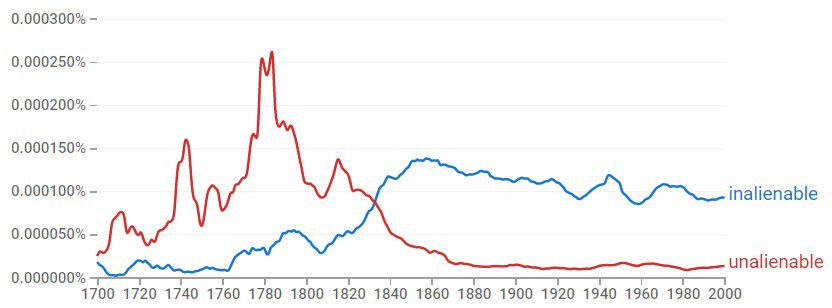
Although English usage rarely takes etymology into account, it’s worth noting that inalienable is truer to the word’s Latin and French roots, for what that’s worth. In- is a Latin negative prefix, and un- is an English one. While the founders’ Anglicized word remains an accepted variant, the more Latin form became more common around the beginning of the 19th century and has remained ascendant ever since.
This ngram, which graphs occurrence of the two forms in a large number of English-language books and periodicals published from 1700 to 2000, renders the history visually (note the large spike after 1776):
Examples
Unalienable is usually used in reference to the Declaration of Independence and its arguments—for example:
Our nation was predicated on unalienable rights with governance through family, church and community, each rightfully sovereign within its sphere. [Forbes]
Mr Gingrich recurs constantly to the Declaration of Independence’s premise that men “are endowed by their Creator with certain unalienable rights”. [Economist]
Why should the unalienable rights – among them life, liberty and the pursuit of happiness – proudly celebrated by Americans on July 4 not be extended to humans everywhere? [Gulf Daily News]
And inalienable is used everywhere else—for example:
The speed with which the German government is shifting inalienable positions is breathtaking. [Financial Times]
That sentence is structured as an inalienable fact because it is. [Mirror]
It was ignored that ‘corruption’ is an inalienable part of bourgeois politics. [Republica]
Comments are closed.