


Dwarfs is the standard plural of the noun dwarf. Dwarves is a newer variant popularized (though not invented) by English author J.R.R. Tolkien in his fantasy fiction works, including The Hobbit and The Lord of the Rings. The Tolkien spelling is appropriate when referring to little people in fantasy worlds. Dwarfs is better everywhere else. (There is controversy over whether dwarf is ever a polite term for real-life people, but we won’t go into that here.)
Dwarf also works as a verb meaning to cause to appear small in size. In this sense, dwarf is inflected dwarfs, not dwarves, in the third-person singular present tense.
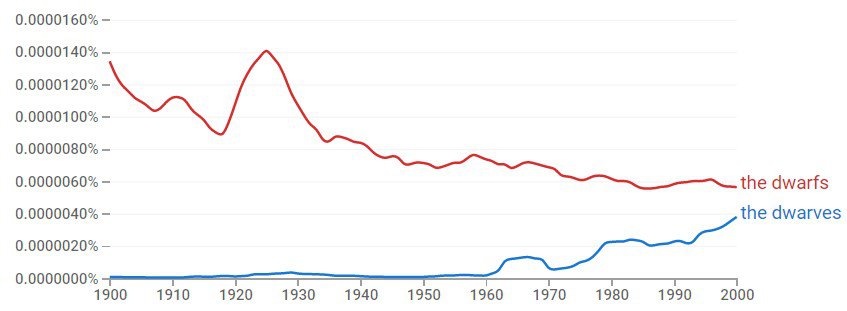
The below ngram graphs the occurrence of the dwarfs and the dwarves (with the definite article to remove instances of the verb sense) in a large number of English-langage texts published in the 20th century. Of course, it doesn’t show how the words are used, but it does indicate that dwarfs was much more common than dwarves at the start of the century, which is also apparent in historical Google Books searches limited to pre-1930 texts. That dwarves has gained ground in the decades since Tolkien’s books were published makes perfect sense, as his writing is very popular and widely discussed. Plus, due to his influence, dwarves now make its way into non-fantasy contexts much more often than it used to.
Examples
Dwarves
The latest teaser picture for the forthcoming adaptation of the Hobbit has been released, showing a trio of hardy warrior dwarves. [Daily Mail]
Along the way they encounter dragons, dwarves, merfolk, and a band of lost warriors before reaching the edge of the world. [NJ.com]
This world is made up of wizards, dwarves, witches, vampires and a variety of other characters. [Guardian]
Dwarfs (noun)
Most varieties grow about two feet tall, though some dwarfs are only half as tall. [Sioux City Journal]
Dwarfs tend to be used for “eating fresh,” and the tall forms for coconut oil and for fiber. [Laboratory Equipment]
The brown dwarfs are an estimated to be 15 light years and 18 light years from the sun. [MyFox Atlanta]
Dwarfs (verb)
God is poking his tongue through the Puyehue volcano, whose carbon output dwarfs industry’s. [Sydney Morning Herald]
A giant drill, used for projects like the Chilean Miners rescue, dwarfs nearby houses in Newcastle’s West End. [BBC]
[no_toc]
Comments are closed.