


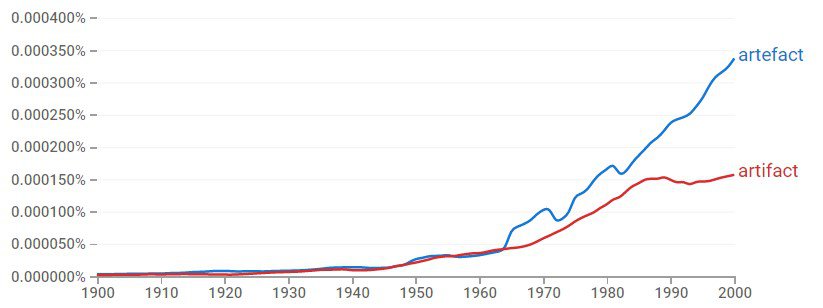
Artefact is the British spelling of the noun meaning, primarily, an object shaped by human workmanship, especially one of historical or archaeological interest. Artifact is the American spelling. Both spellings are etymologically justifiable, and both are hundreds of years old in English. The British preference for artefact is a new development. The two forms vied for ascendancy in British writing through much of the 20th century until artefact finally gained the upper hand around 1990. The following ngram, which graphs the use of artefact and artifact in a large number of British books and periodicals published from 1900 to 2019, renders the story in visual form:
The corresponding graph for American publications is much more straightforward:
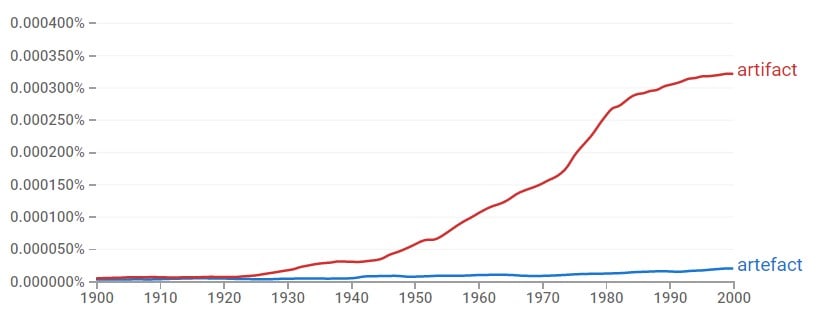
Canadian writers tend to use the American spelling. Artefact is more common everywhere outside North America.

Examples
These examples are from American and Canadian publications:
The sudden suicide of an artifact-dealer with ties to the cult draws the attention of an ambitious female police detective-inspector. [Wall Street Journal]
Buried artifacts, preserved in the ashes, are coming to light. [Montreal Gazette]
One artifact of Obama’s “leading from behind” foreign policy is a sense that many of our allies had it coming … [National Review Online]
And these are from outside North America:
Some bandits had made off with a golden artefact owned by the local storekeeper and with the aid of a new found ally … [Guardian]
€310k – The price of the most expensive oriental artefact ever sold at auction in Ireland. [Irish Times]
The best-known artefact is the teenage monarch’s gold funerary mask, which stares out from a case on the first floor of the museum. [The Age (Australia)]
References
1. “Artifact” at Etymology Online ^
2. http://www.oed.com/view/Entry/11133 ^
Comments are closed.