


Okay is a commonplace term that is understood world-round, but you may find it spelled differently from one text to another.
Does that mean one has a different definition, should be used in a different context, or is one way more acceptable than another?
Not quite. If you have been cautious about whether it should be OK, okay, or O.K., you aren’t alone. Let’s look at where this word came from, how it should be used, and why you can use either spelling without fear of confusing your readers.
What’s the Difference Between Ok and Okay?

OK is actually the original version from which okay is derived from. At some point, somebody decided to spell the sound “o” and “k” make when placed together, but rest assured, nothing changes about its definition or use with either version.
In fact, the two-lettered spelling OK is sometimes separated by periods. Okay, OK, and O.K. are all acceptable spellings of the word and what you use is a matter of preference.
The word has several main uses. As an adjective, it’s synonymous with acceptable, passable, or good. Something that is OK is positive but not as positive as it could be.

For example:
- The essay she turned in was just okay since I felt she could have put a little more effort into it.
- Is she OK after her accident?
- It was an okay party. I just wish more people had shown up.
It also works as an interjection used to express agreement or approval.
For example:
- Okay! Let’s get started!
- I’m looking for confirmation. Does everyone understand? Okay?
- Okay, okay! Things are looking good. Now let’s add to this experience.
An interjection extends its verb sense to agree or approve.
For example:
- She okayed my research topic so I could move forward with the project.
- I’m OK’ing this assignment as long as you make sure to turn your future work in on time.
From the verb extends its noun sense, agreement or approval.
For example:
- He received the okay he needed to move forward with the project.
- The teacher gave her the okay to turn in the term paper late due to my sickness last week.
- It’s OK with me if she tags along to the movie.
Is OK Capitalized?
Okay is written as any other word, in lowercase unless it’s at the beginning of a sentence.
OK is always spelled with capital letters (as is O.K.) as the generally accepted form since it is, in theory, the acronym of oll korrect, which is explained below.
Origin and Popularity of Use
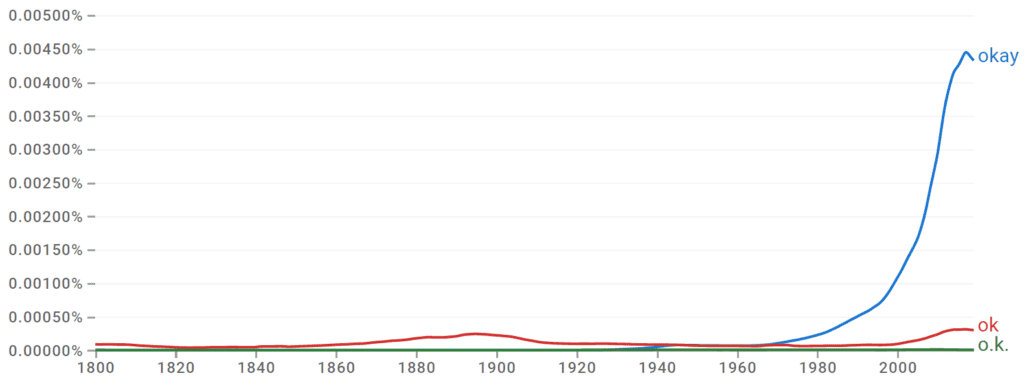
There are many theories about the origins of the word, some more plausible than others. The Oxford English Dictionary and the Chambers Dictionary of Etymology agree that it apparently has an early-19th-century American origin in the abbreviation of oll korrect, a jocular misspelling of all correct.
Okay is more common in edited writing, but OK appears about a third of the time.
Some of the oldest written references stem from the slogan used in 1840 by the American Presidential candidate, President Martin Van Buren, who was seeking another term in office. His nickname was “Old Kinderhook,” and supporters called themselves the “OK Club” as a campaign slogan.
Let’s Review
Okay, OK, and O.K. are all the same words and can be used interchangeably with one another in both informal and formal writing scenarios. In fact, OK is the original preferred spelling of the word, with other versions following. It can work as an adjective, noun, verb, or interjection.
Comments are closed.