


Paralyse and paralyze are different spellings of the same word. Paralyze is preferred in the U.S. and Canada, while paralyse is preferred outside North America. The spelling difference extends to derivative words such as paralysed/paralyzed and paralysing/paralyzing, but not to paralysis, which has two s‘s everywhere.
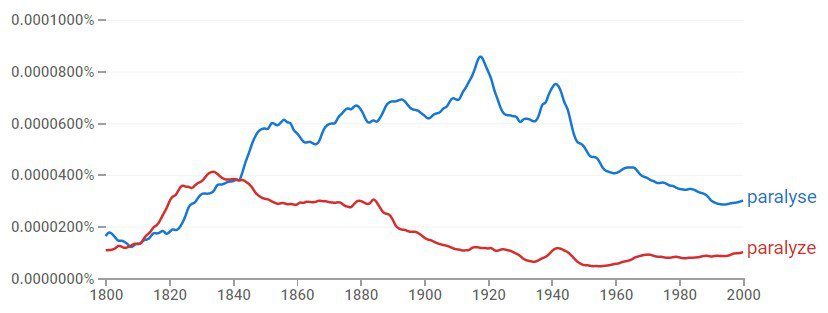
Both spellings are old, and it was not until the middle 19th century that English speakers on both sides of the Atlantic settled on their respective spellings (though Americans settled on theirs a little earlier). This ngram shows both spellings’ use in a large number of British texts published from 1800 to 2019:
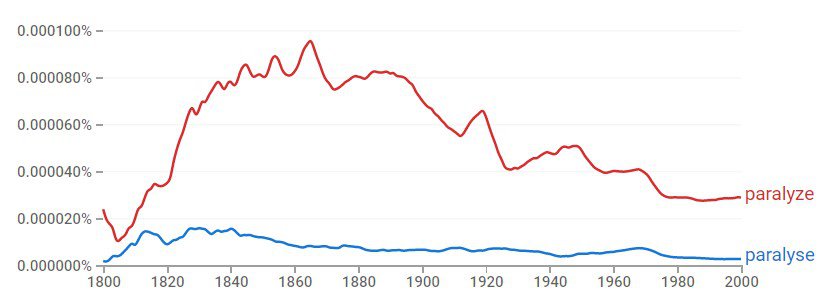
And this ngram graphs the the same for American English:
Examples
North America
With the bond severed between fearful memory and its object, a phobia loses its power to paralyze. [Los Angeles Times]
Opposition members are threatening to withdraw their support of the Speaker, which would paralyze the National Assembly. [Globe and Mail]
Patients remain in an unconscious, paralyzed state for at least 24 hours and then the body is allowed to slowly warm. [Arizona Republic]
Outside North America
But while Iraq should inform us, it should not paralyse us. [Guardian]
Gillard is doing enough on her lonesome to paralyse her government. [Sydney Morning Herald]
This town is not the only area of Tamaulipas, a state of the size of the Czech Republic, virtually paralysed by violence. [BBC]
Comments are closed.