


Humor and humour are different spellings of the same word. Humor is preferred in American English, and humour is preferred in all the other main varieties of English. The distinction extends to the derivative participles—humored/humoured and humoring/humouring.
People often ask if it’s humourous or humorous. Even though the spelling of humour is used in Canada and the UK, the spelling of humourous is not commonly used. The adjective should be spelled as humorous in most examples.
Now, you might be thinking, “Why should I bother learning both?” Well, getting a grip on these nuances doesn’t just polish up your spelling game; it gives a big boost to your grammar and showcases your adaptability in communication. After all, it’s all about understanding and being understood, right?

So dive into this guide, and I promise, by the end of it, you’ll be a pro at flipping between the two like it’s no big deal!
How Do Canadians Spell Humorous?
People in Canada and the UK often share the same spellings of certain words. So, it’s common to see the use of humourous (from humour with an ‘our’) for both. However, the spelling of humorous is actually the correct way and more widely accepted and used worldwide.
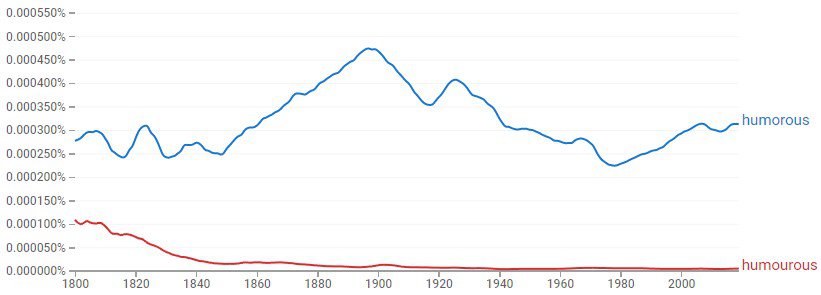
Google NGrams shows that the spelling of humorous has been more commonly used over the years versus the spelling of humourous as you can see in the graphs below.
Examples Of Humor In A Sentence
U.S.
This is not to say that first-rate humor can’t be squeezed out of the spy game. [Washington Post]
But the level of humor—much of it distinctly of the bathroom variety—is aimed squarely at the under-13 set. [USA Today]
Alàs’s work is full of these humorous touches, which convert potentially cold conceptual pranks into warm, whimsical human experiences. [Boston Globe]
Outside the U.S.
With Ross’s keen editorial observations, his self-deprecating humour and his supporting cast of characters, Eyes is a welcome addition to my shelves of newspaper noir. [Calgary Herald]
It’s all very good humoured, in a British way, however much people worry that the civic character of the town is being eroded. [Telegraph]
Examples of Humorous In A Sentence
Hundreds of comments have also been left on the auction, ranging from humorous puns and questions to praise for Johnson’s initiative. [Stuff.co.nz]
The second play, Greek is a humorous twist on the Oedipus legend reflected in 1980s London culture. [BBC News]